New exhibition: Jaroslav Valečka's Dark Lyricism brings paintings full of stories, memories, and silence to Prague
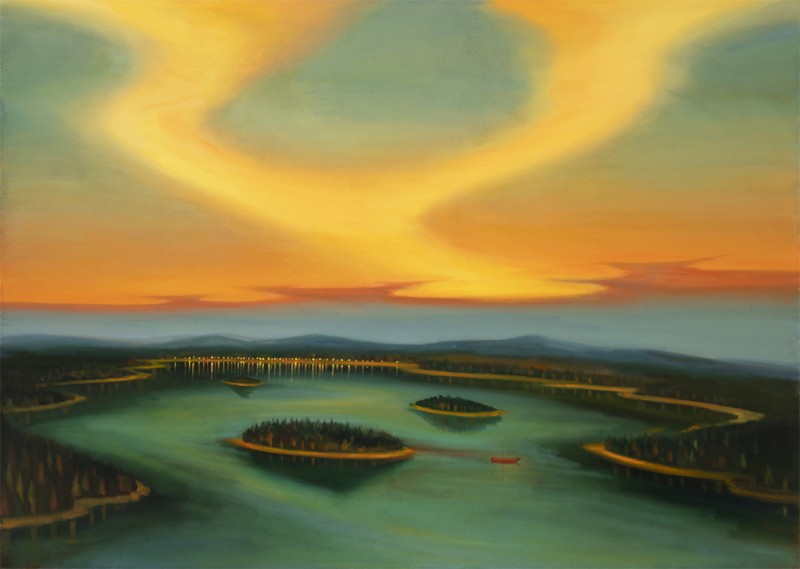
The Czech Gallery of Modern Art is opening a new exhibition, Jaroslav Valečka: Dark Lyricism. A collection of paintings based on the landscape of northern Bohemia is coming to the center of Prague, transforming it into a personal, sometimes dreamlike, and sometimes disturbing world. Valečka is one of those artists whose paintings are not just about what we see, but mainly about what we take away from the image.
Paintings that do not tell a story literally
The paintings seem like frozen moments in stories that are never fully told. The viewer has the space to imagine, supplement, and compose them in their own way. Darkness is not a threat here, but rather a quiet tension. Melancholy naturally mixes with humor and exaggeration, seriousness with grotesque detail.
"For me, dark lyricism is not about hopelessness, but about the tension between light and shadow, between what we know and what we carry within ourselves," says Jaroslav Valečka.
The Sudetenland as an inner landscape
Northern Bohemia, especially the area around Česká Kamenice and the Lusatian Mountains, plays a fundamental role in his work. However, it is not the landscape itself that matters, but rather the landscape of memory, stories, and feelings. Places that bear traces of the past are transformed in his paintings into backdrops for strange, sometimes fairy-tale-like dark situations.
"Valečka's painting is rooted in the landscape and its memory. The Sudetenland is not presented here as a historical theme, but as an inner space where personal memories, myths, and collective experience meet," adds exhibition curator Renáta Mužíková.
Paintings with a story within reach
Valečka is interested in the moment when we are no longer sure whether we are looking at the real world or our own memories. It is precisely this uncertainty that creates the tension conveyed by his paintings. Muted colors, strong contrasts of light and shadow, and distinctive brushwork create an atmosphere that is more emotional than descriptive.
"I am interested in the moment when reality begins to break into something dreamlike," says the author.
The exhibition will also feature QR codes that will allow visitors to access the stories that inspired the individual paintings. The exhibition will thus offer not only a visual experience, but also an opportunity to look beneath the surface of the work itself.
Exhibited artworks
Among the works on display will be, for example, the painting Stilt Walkers (2025), inspired by the world of carnival masks and folk "surrealism." "I have always been fascinated by masquerades, where people put on animal masks, add wings, and create beings that embody their fears and fantasies," says Valečka.
Another notable work is Bouře (Storm, 2025), which is based on the artist's memories of the Belveder viewpoint above the Elbe. "As boys, we used to go there to watch the approaching storms breaking over the Elbe valley. I never tire of that feeling of tension," he adds.
One of the most prominent painters
Jaroslav Valečka has long been one of the most prominent figures in contemporary Czech painting. He graduated from the Academy of Fine Arts in Prague, has been exhibiting since 1999, and his paintings are part of the collections of the National Gallery in Prague, the Regional Gallery in Liberec, and GASK in Kutná Hora. British art historian Edward-Lucien Smith has written about his work, and Valečka's creations regularly appear at international auctions, including Sotheby's.
In addition to paintings, the exhibition will also offer QR codes that will connect the paintings with the stories that inspired their creation.
Czech Gallery of Modern Art
Betlémské náměstí 8
Prague 1
110 00
goma.cz
Open: Tuesday to Sunday, 11 a.m. to 7 p.m.
Opening: Wednesday, February 4, 2026, at 6 p.m.
The exhibition will run from February 5 to March 15, 2026.
Accompanying program:
Guided tours – Tuesday, February 10, and Wednesday, March 11
Evening reading – Thursday, March 5